Thought Leadership
Why Small-Batch Skincare Delivers Fresher, More Effective Formulas — and What Mass Production Gets Wrong
By Rose + Thyme · 11 min read · May 17, 2026
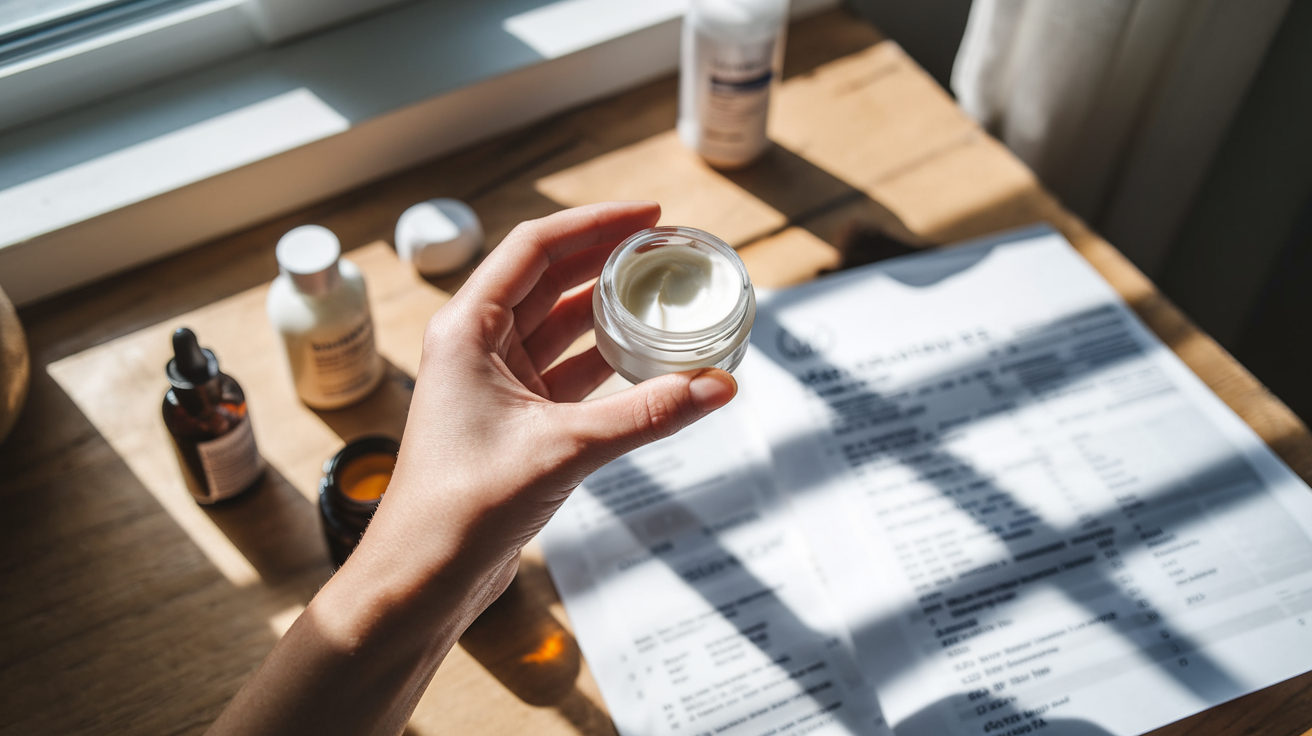
You switched to clean beauty to protect your skin. You read the labels, avoided the sulfates, cross-referenced the INCI lists. But here is a question almost no brand will ask you to consider: how long has that 'clean' bottle been sitting in a warehouse before it reached your bathroom shelf?
Most clean beauty labels are designed to tell you what is not in the formula. Almost none tell you how long that formula has been aging in transit. And that silence has real consequences — not just for your peace of mind, but for the ingredient potency you paid for and the skin results you were expecting.
This is the part of clean beauty that greenwashing has successfully buried. The ingredient list can be spotless. The certification badge can be legitimate. And the active ingredients can still have spent six months oxidising in a distribution centre before the box landed on your doorstep. The preservative load in your 'gentle' moisturiser might have nothing to do with your skin type — and everything to do with a supply chain built for scale, not freshness.
The Problem With Mass-Produced Skincare: How Long Has That Bottle Been Sitting There?
Here is how a typical mass-market skincare product reaches you. It is manufactured in a large batch — thousands to tens of thousands of units — then held at a third-party logistics facility, shipped to a regional distribution hub, allocated to individual retailers, placed on shelves, and eventually purchased. At each stage, time passes. Heat and light fluctuate. And the clock on ingredient stability keeps running.
Industry supply chain structures mean that the gap between when a formula is made and when a consumer opens it can extend to many months or longer — sometimes considerably so for slow-moving SKUs.
Mass-market brands account for this reality in one specific way: they preserve aggressively. The preservative system in a large-batch product is not calibrated to the time between your purchase and when you finish the bottle. It is calibrated to the worst-case scenario — the longest possible time the product might exist before it reaches you, plus the longest possible time you might use it afterward. That worst-case math produces higher preservative concentrations than sensitive or reactive skin often tolerates.
For Maya — the clean beauty convert who attributed her reactions to 'harsh ingredients' — the actual culprit may have been a preservation system sized for an extended supply chain, not for her skin type. That distinction matters, and the beauty industry has little incentive to draw attention to it.
What 'Small-Batch' Actually Means — and What It Doesn't
Small-batch has followed the same trajectory as 'natural' and 'clean' — it started as an operational description and became an aesthetic one. Today you will find the phrase on packaging from brands whose production volumes would not qualify as small by any manufacturing standard. That gap between the label and the reality is worth understanding before you take any brand's word for it.
In genuine small-batch skincare, the term describes an operational constraint, not a design choice. Batches are limited in unit count. Production cycles run more frequently. Inventory turns over faster. The result is a shorter, more predictable window between when a formula is made and when it ships to a customer. That window is the variable that drives every meaningful downstream benefit — from ingredient freshness to preservative load to formula stability.
Rose + Thyme produces in small batches so that nothing sits — and nothing settles. That is a structural claim, not a marketing one. It means production runs are sized to match actual demand cycles, not to fill a warehouse for the next quarter. It means the formula that arrives at your door is closer to the day it was made than its mass-market equivalent would be by design.
If you want to audit a brand's small-batch claim before you buy, ask four questions: What is the maximum batch size? How frequently do you produce each SKU? What is the maximum age of a product at point of dispatch? Do you print manufacture dates on packaging? A brand with genuine small-batch operations can answer all four. A brand using the term decoratively will struggle with the first one.
Fewer ingredients. Better reasons for every one. That principle applies to how Rose + Thyme produces as much as to what goes into the formula.
Active Ingredients Degrade Over Time: The Science of Skincare Freshness
The stability of a skincare formula is not fixed at the moment of manufacture. From that point forward, time, heat, light, and air work against it — at rates that vary by ingredient but in directions that are consistent and well-documented in cosmetic chemistry.
Vitamin C (most commonly formulated as L-ascorbic acid) is among the most oxidation-sensitive actives in skincare. When oxygen interacts with ascorbic acid over time, the molecule converts to dehydroascorbic acid and eventually to diketogulonic acid — a form that has no brightening activity. A vitamin C serum that has oxidised is not simply less effective. It is not doing the job it was formulated to do. The orange or brown discolouration that signals oxidised vitamin C is visible evidence of functional degradation — and it can occur before a product is ever opened if storage conditions are unfavourable.
Peptides — short chains of amino acids used in skincare to signal collagen production and support barrier function — are vulnerable to hydrolysis, a process in which water molecules break peptide bonds over time. A peptide formula that has hydrolysed will not deliver the same collagen-signalling activity as a fresh one. The degradation is invisible in the bottle but measurable in the skin results.
Botanical antioxidants, including plant-derived polyphenols, flavonoids, and carotenoids, are sensitive to both light (photodegradation) and heat. Antioxidants in transit through warm distribution environments lose protective capacity before the product is ever used on skin. This matters particularly for formulas marketed for their botanical ingredient science — the efficacy claim depends on the botanical arriving intact.
The practical conclusion is not that skincare is ineffective. It is that freshness is a functional requirement for efficacy, not a luxury preference. A formula can be perfectly constructed and still underperform if the active ingredients it relies on have been degraded by the time they reach your skin. Your skin deserves to know exactly what it is absorbing — including whether the actives the label promises are still present in meaningful concentrations.
Source: pmc.ncbi.nlm.nih.gov/articles/PMC8773188
Why Smaller Batches Mean Lower Preservative Loads — and Gentler Formulas
There is a structural logic to preservation in skincare that the industry rarely explains to consumers, because explaining it would require being transparent about how mass production actually works.
Every preservation system in a skincare formula must account for a worst-case timeline: the longest the product might sit in a warehouse, the longest it might be displayed in a retail environment, and the longest a consumer might use it after purchase. For a mass-market brand distributing through global retail networks, that worst-case window can span eighteen months to two years of combined time — an illustrative estimate reflecting the outer limits of typical distribution cycles rather than a codified industry standard. The preservation system must hold the formula safe and stable across that entire span. That requires concentrations calibrated to the outer limits of the timeline — not to the actual purchase window of a typical consumer.
Small-batch production removes the extended warehouse and retail display phases from that equation. When inventory turns over quickly and products are dispatched closer to manufacture, the window the preservation system must cover becomes shorter and more predictable. The result is a simpler, lighter preservation approach — fewer preservative compounds, at lower concentrations, because the formula does not need to withstand eighteen months of uncertain storage conditions.
For sensitive or reactive skin, that difference is not incidental. Common preservative systems used in mass-market formulas — including certain parabens, formaldehyde-releasing agents, and high-concentration alcohol — are documented sensitisers for reactive skin types. When those preservatives are present at elevated concentrations because of a supply chain requirement rather than a formulation one, the sensitive-skin consumer is absorbing a preservative load that exists for logistical reasons, not skincare ones.
Rose + Thyme's formulation philosophy — fewer ingredients, with better reasons for every one — is not simply a values statement. It is a structural outcome of how the brand produces. Small-batch runs with faster sell-through mean the preservation system can be lighter by design, not by accident.
How to Read a Skincare Product's Freshness Signals: Batch Codes, PAO, and Best-Before Dates
Your skincare's freshness begins with how it's made. Rose + Thyme produces only 50 units of each formula at a time — a deliberate constraint that eliminates the need for complex freshness decoding.
The Period After Opening (PAO) symbol is the open-jar icon on cosmetic packaging, followed by a number and M — for example, 12M or 24M. It tells you how many months a product remains safe and effective after you first open it. Because we make in small batches, the product reaching your hands is recent. Our 12M window reflects true usable life from opening day.
Batch codes are the letter-and-number sequences printed on the base or back of packaging. They're manufacturer traceability tools — allowing us to trace any formula back to its specific production run. For you, they're proof of accountability. You can verify when your product was made and know it hasn't lingered in inventory.
Best-before versus expiry dates signal different things. Best-before marks when a product may lose potency or stability. Expiry marks when it becomes unsafe. Our best-before dates are meaningful — they reflect when active ingredients perform at peak strength. Because batches are small and move quickly to you, you're working within that optimal window.
Rose + Thyme's transparency isn't just words on packaging. It's built into how we produce: smaller batches, fresher products, shorter supply chains. You know exactly what you're getting and when it was made.
Rose + Thyme's Production Cycle: From Formulation to Your Doorstep
Transparency about production is where most clean beauty brands stop short. They will tell you what is in the formula. They will not tell you how long that formula has been aging before you received it.
Rose + Thyme's small-batch model is built around a specific commitment: the gap between when a product is made and when it ships to a customer is kept deliberately short. Products are dispatched within 3–4 weeks of manufacture. Maximum batch age at point of dispatch is 28 days.
That commitment is not aspirational — it is structural. Limited batch sizes mean production runs more frequently and inventory does not accumulate in storage. Direct-to-consumer distribution removes the retail display phase from the timeline entirely. The result is that the formula you open is fresher than a comparable mass-market product would be — not because of a promise on the label, but because of how the operation is designed.
This is the part of clean beauty that the industry has not yet been asked to be transparent about. Ingredient lists have become a standard disclosure. Production timelines have not. Rose + Thyme believes that your skin deserves to know exactly what it is absorbing — and that includes knowing how fresh the formula is when it arrives.
The preservative system is lighter because the supply chain is shorter. The active concentrations are higher because the formula has not spent months in transit. The ingredient list is shorter because there is no need to compensate for a worst-case distribution scenario that this production model eliminates by design.
What This Means for Your Routine — and What to Ask Any Brand You Consider
If you are rebuilding a skincare routine around genuinely clean, genuinely effective formulas, freshness is a variable worth interrogating — not just ingredient purity.
The questions to ask are practical ones. Does this brand publish or disclose its production timeline? Does the packaging carry a manufacture date, or only a PAO symbol that tells me nothing about age at purchase? Is 'small-batch' an operational claim with specific numbers behind it, or a phrase on the label with no constraint behind it?
For Priya, who has tried a dozen hyaluronic acid serums and found them either ineffective or irritating, the freshness question is directly relevant: a serum that has spent months in distribution before you opened it is not the same product the formulator intended. For Maya, who switched to clean beauty to eliminate unnecessary irritants, knowing that preservative load is driven by supply chain timelines — not skin compatibility — reframes where to look when a 'gentle' product still causes a reaction.
Rose + Thyme exists at the intersection of those two requirements: formulas that are genuinely clean and genuinely fresh. The small-batch model is not a marketing distinction — it is the operational reason both of those things are possible at the same time.
If you want to experience what a short supply chain actually feels like on your skin, start with a single product. Read the ingredient list — it will be short, and you will recognise every entry. Check the batch code. Look at the PAO window. And notice the difference between a formula that was designed to survive a global distribution network and one that was made to reach you quickly, with everything intact.
Your skin can tell the difference. Now you can too.
Frequently asked questions
- How long does skincare typically sit in a warehouse before it reaches consumers?
- Mass-produced skincare can spend anywhere from several months to over a year moving through manufacturing, third-party logistics, retail distribution, and shelf display before a consumer purchases it. The exact timeline varies by brand and retailer, but industry supply chain structures routinely result in significant gaps between formulation and use. This is why large-batch products must be preserved for worst-case scenarios — not for the actual window between your purchase and when you finish the bottle.
- What does 'small-batch' mean in skincare production?
- In genuine small-batch skincare, production runs are intentionally limited in unit count, resulting in shorter manufacturing cycles, faster inventory turnover, and a narrower window between when a product is made and when it is sold. This is distinct from brands that use 'small-batch' as a branding term without operational constraints on batch size or production frequency. A brand with genuine small-batch operations should be able to disclose its maximum batch size, production frequency, and maximum product age at point of dispatch.
- Do skincare active ingredients really degrade before you open the bottle?
- Yes. Many active ingredients — including vitamin C, peptides, and botanical antioxidants — begin to degrade through oxidation, hydrolysis, or light exposure during storage and transit, even in sealed packaging. Vitamin C oxidises and loses brightening activity; peptides hydrolyse and lose collagen-signalling function; botanical antioxidants break down under heat and light. The rate of degradation depends on the specific ingredient, packaging design, storage conditions, and elapsed time since manufacture.
- What is the Period After Opening symbol on skincare packaging?
- The Period After Opening symbol is the open-jar icon printed on cosmetic packaging, followed by a number and the letter M — for example, '12M'. It indicates how many months a product remains safe and effective after it has been opened for the first time. It does not indicate the product's age at point of purchase, nor does it reflect how long the product was in storage before you bought it. A product marked 12M that spent ten months in a warehouse before reaching you may have only two months of effective use remaining.
- Why do small-batch skincare brands use fewer preservatives?
- Because small-batch producers move inventory faster, they can formulate for a shorter and more predictable shelf life. Mass-market brands must preserve aggressively to account for extended warehouse dwell times, long retail display periods, and variable storage conditions across global distribution networks. When those extended timelines are removed from the equation, preservation systems can be simpler, lighter, and less likely to cause irritation — particularly for sensitive or reactive skin types.
- How can I tell when a skincare product was manufactured?
- Most skincare products carry a batch code — a sequence of letters and numbers printed or embossed on the base or back of the packaging. This code is a manufacturer-side traceability tool, and for some brands, third-party batch code checkers can decode the manufacture date from it. The Period After Opening symbol tells you how long to use a product after opening, not how old it was when you bought it. Brands committed to transparency may also print a best-before or manufacture date directly on packaging.